
Volunteering in a residential care home? 5 lessons from Vrije Wil
What do residential care home residents really need from volunteers? UCLL researchers spoke with residents, staff, and volunteers across four care homes. Their findings show that simple presence, active listening, and meaningful personal connections often matter most. Discover five valuable lessons to guide your journey.

What does someone in a residential care home really need from a volunteer? UCLL University of Applied Sciences went to ask them.
Researchers Yasmine Sterckx and Liesbet Van Vlasselaer listened to residents, volunteers, informal carers and care staff in four residential care homes. This resulted in a free online inspiration guide and the magazine Van Binnenuit, packed with stories from daily life. We read it and drew five lessons from it.
Want to make a difference yourself? Search Give a Day to find volunteering work in a residential care home near you.
Vrije Wil in short
Research: the practice-oriented research Vrije Wil by UCLL
Researchers: Yasmine Sterckx and Liesbet Van Vlasselaer
Where: four residential care homes: Huize Nazareth (Goetsenhoven), Sint-Margaretha (Holsbeek), Sint-Jozef (Pelt) and Kloosterhof (Oudsbergen)
How: conversations, observations and storyweaving, a method for bringing residents' stories to the surface
Partners: Present, the Flemish Support Centre for Volunteering, the Flemish Older People's Council and Samana
Result: a free online inspiration guide and the magazine Van Binnenuit
1. You don't have to do much. You just have to be there.
The first chapter of Van Binnenuit is called "doing less, being more". That sums up the entire research project.
Care staff are busy. Volunteers have something that is scarce in care: time. An 83-year-old resident puts it like this: “Volunteers have more time to have a chat.” And about the volunteer who delivers books: “The lady on the book round brings the outside world inside for me.”
A nurse saw a young volunteer who was mostly given odd jobs elsewhere. She saw it differently: “You are here for the people, they need you.”
2. Start from the resident, not the activity
The researchers mainly looked at what contact with volunteers triggers in residents. Peace, enjoyment, safety, curiosity, gratitude. This shifts the question from "what needs to be done?" to "what experience do we want to create?".
And not every resident wants the same thing. One female resident is clear about that: “I'm quiet, I don't need a lot of laughing and fussing.”
For her, a quiet conversation is worth more than a full afternoon of activities. For someone else, it's the exact opposite. So just ask.
3. With a volunteer, a resident doesn't have to pretend to be someone else
A volunteer is neither a healthcare provider nor family. That is precisely why a resident can speak freely.
An 80-year-old resident about the volunteer who visits every week: "I can argue with him, so to speak. I can say anything to him. That's a relief. I have to put on an act with the care staff."
A 65-year-old resident about her regular volunteer: "I can tell her more than I can tell my family or the care staff."
4. Help, but don't take over
Well-intentioned isn't always good. If a volunteer makes the flower arrangement instead of the resident, it might look nicer. But the resident loses something: a piece of self-worth.
A staff member who works with residents and volunteers every day puts it like this: “Even if it doesn't look perfect, they did it themselves. And that is worth so much.”
Boundaries are part of it too. The guide gives a concrete example: a volunteer operating a hoist themselves. That is a care action that only staff carry out, as it is risky for both the volunteer and the resident. How you discuss this without hurting the volunteer's feelings is what the guide calls "warm boundary-setting".
5. Volunteers want to know if they are doing well
Volunteers need something too. In the study, they kept asking the same question: "am I doing it right?". They want feedback, follow-up and recognition.
Alice, who was a volunteer herself, puts it briefly: volunteers need to know that they are indispensable. "Tell them."
And more are needed. Pol, Germaine and Luc have been helping residents for more than 25 years. Where twenty residents used to go for a walk, today there are seven at most. The number of volunteers has also dropped. What they notice most: "Young people aren't joining anymore."
Do you want to become a volunteer in a residential care home?
You don't need a healthcare qualification. According to the magazine, two thoughts hold people back most often: "I don't know it" and "I can't do it". While just a few hours a month can already make a difference.
Hugo, a volunteer in the cafeteria, puts it in his own words: "Just do it, because you get a lot back in return, right."
Read the stories in Van Binnenuit before you start.
Do you work in a residential care home?
The inspiration guide is free and full of material you can start using today:
Storyweaving: a script for a 15 to 30 minute conversation to discover what residents expect from volunteers
Volunteer bingo: a playful conversation tool with two bingo cards, one about experiences and one about wishes
Volunteer survey: a guide to surveying your volunteers
BUSC method: a quick reference card for giving brief and warm feedback
Ten appendices for a sustainable volunteer policy, from recruitment to warm boundary-setting
No heroic deed. Just being there
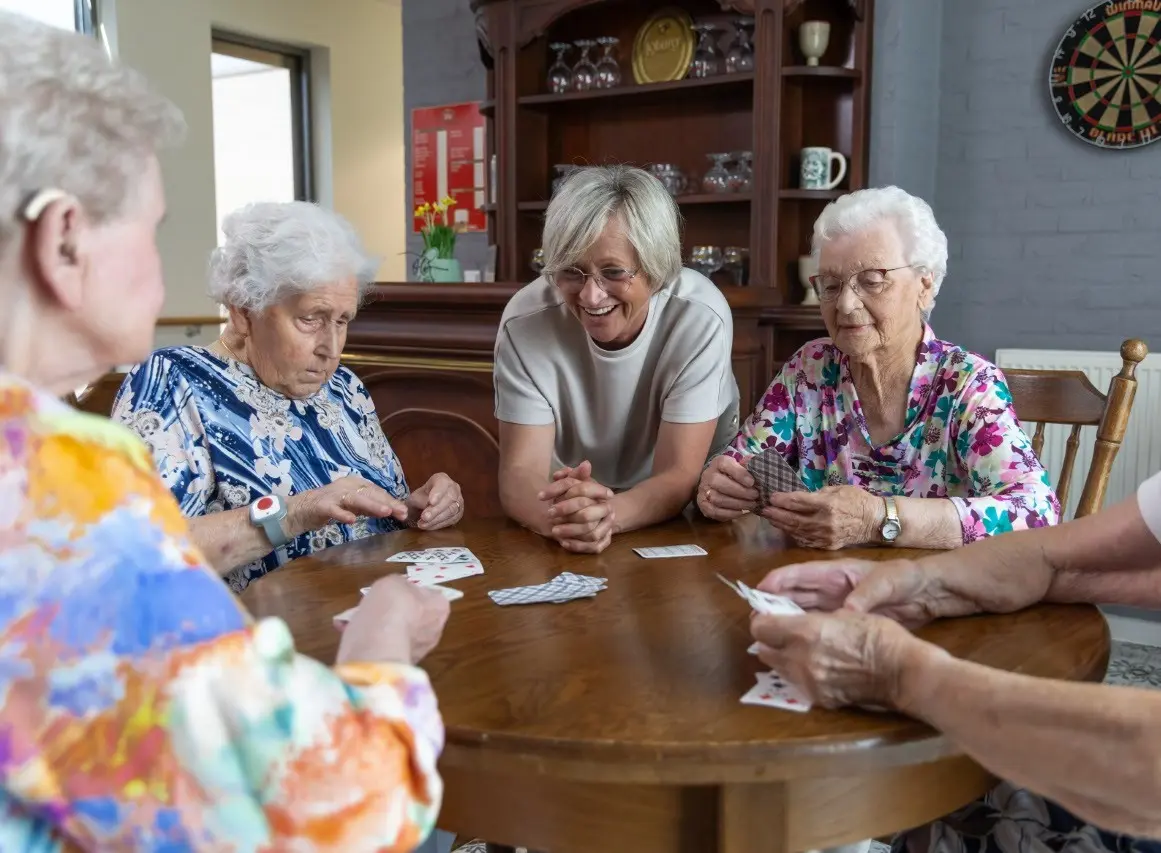
A chat. A walk. The fourth player at the card table. These are small things, but for someone living in a residential care home, they make their day.
Linda has been dedicating herself to residents together with her partner for thirteen years. She summarizes it like this: "It asks for nothing, but it gives everything."
Feel like trying it yourself? Search for volunteering work in a residential care home near you.
See you soon!
Sources
UCLL, Inspiration guide Volunteers in residential care homes
UCLL, Van Binnenuit. Stories of people who bring (more) colour to the residential care home
UCLL, Vrije Wil project page
With thanks to Yasmine Sterckx and Liesbet Van Vlasselaer from UCLL. All quotes are taken from the magazine Van Binnenuit.
Related news and stories
Volunteer at five organisations: Marc's story
Marc volunteers for five different organisations in Aalst, yet he only has one fixed weekly appointment in his diary. How does he balance multiple commitments without feeling overwhelmed? Discover five practical lessons from Marc on setting boundaries, managing your schedule, and finding joy in volunteering.
Volunteering with a disability: Glenn's story
After his accident, Glenn faced dozens of closed doors. That changed when a volunteer organisation asked him: "What do you still want to do?" Read Glenn’s powerful story of volunteering with a brain injury, and get five practical tips on how your organisation can truly empower volunteers with disabilities.